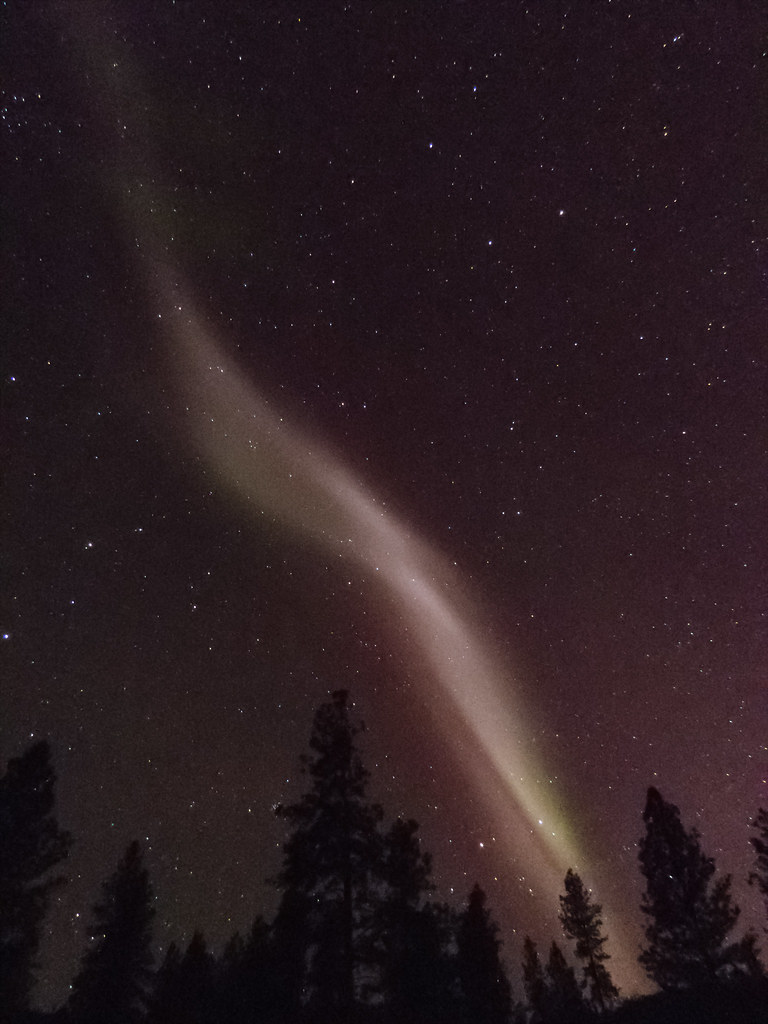
If you've spent time in aurora-chasing Facebook groups or subreddits, you've probably seen a photo of a thin mauve ribbon slicing across the sky, sometimes with a ladder of green stripes hanging beneath it, and someone in the comments asking "wait, is that the aurora?" The honest answer is: it's related to the aurora, it shows up alongside the aurora, but it isn't the aurora. It's STEVE.
What STEVE Actually Is
STEVE is a narrow, glowing ribbon of mauve or pink light that can stretch for hundreds to thousands of kilometers, aligned roughly east–west, and often appears farther from the poles than a typical aurora does. It's frequently accompanied by a "picket fence," a series of short vertical green columns that hang below the main ribbon like the slats of a fence.
A normal aurora glows because charged particles from the Sun rain down into the upper atmosphere and excite oxygen and nitrogen. STEVE's mauve ribbon isn't caused by that process at all. It's a ribbon of unusually fast, unusually hot plasma flowing through the upper atmosphere, glowing from friction and heat rather than particle bombardment. The green picket fence underneath it, though, does behave more like a genuine aurora.
Where the Name Came From
Amateur aurora photographers, particularly members of the Alberta Aurora Chasers Facebook group, had been photographing this feature for years without a name for it. In late 2016 they started calling it "Steve," borrowed from a scene in the animated film Over the Hedge where characters name an unfamiliar hedge "Steve" simply because it's less frightening than admitting they don't know what it is.
The name stuck, and scientists studying the phenomenon later worked backward from it to build the acronym. According to Wikipedia, physicist Robert Lysak proposed the backronym "Strong Thermal Emission Velocity Enhancement" at the American Geophysical Union's fall meeting in December 2016, and NASA Goddard Space Flight Center's research team adopted it. I don't have a way to independently verify every detail of that account beyond what's reported there, but it's consistent across the sources I checked.
How Scientists Figured Out What It Was
The breakthrough came when physicist Eric Donovan at the University of Calgary, working with citizen-submitted ground photos, was able to predict when the European Space Agency's Swarm satellite mission would fly directly through a STEVE event. When it did, the satellite's instruments recorded dramatic changes as it crossed the ribbon.
These figures are approximate and widely reported (Wikipedia, ScienceAlert, Space.com, SKYbrary), sourced back to the Swarm satellite data described in the original 2018 study. I'd recommend checking the peer-reviewed source directly if you need precise values for research purposes.
For comparison, background plasma outside the ribbon in that same region moves at roughly 10 meters per second. A flow of about 6 kilometers per second is thousands of times faster than that. That extreme speed differential, combined with the temperature spike, is what gives STEVE its glow and its name: a "strong thermal emission" tied to a "velocity enhancement."
STEVE is associated with something space physicists already knew about before STEVE had a name: a subauroral ion drift, or SAID, a fast-moving stream of hot particles in the ionosphere at lower latitudes than the auroral zone. STEVE appears to be the optical, visible signature of a SAID event. Research on exactly why it glows, and why the picket fence forms alongside it, is still active and has been refined multiple times since the initial 2018 study.
Not "Not an Aurora" — More Like "Aurora's Different Cousin"
It's common to see headlines saying "STEVE isn't an aurora," and in the strict sense that's true: a classic aurora is produced by charged particles precipitating into the atmosphere and colliding with oxygen and nitrogen molecules, which is not the mechanism behind STEVE's mauve ribbon. But the picket fence that often accompanies it does appear to involve particle precipitation, similar to a normal aurora, which is part of why researchers describe STEVE and the picket fence as related but not identical phenomena, occasionally showing up together and sometimes independently.
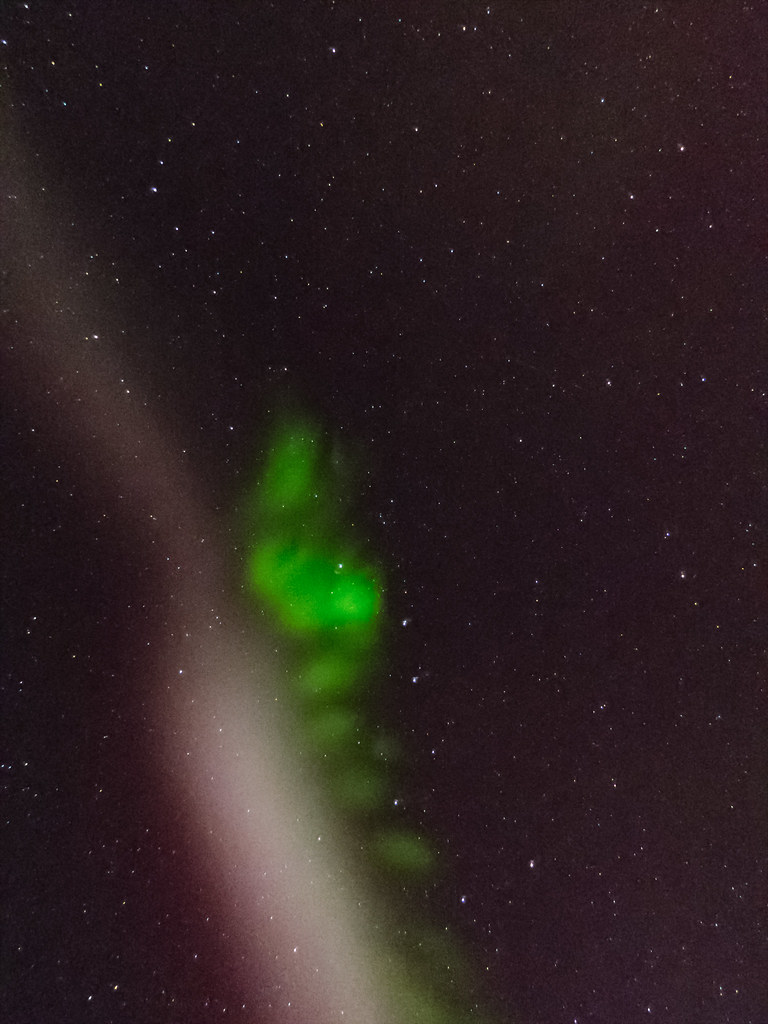
This is also why STEVE can appear at the same time as a genuine aurora display, further complicating identification for anyone watching from the ground.
How to Tell STEVE Apart From a Regular Aurora
- Color and shape: STEVE is a narrow, well-defined mauve or pinkish-white ribbon, not the broad curtains or diffuse glow typical of a green aurora.
- Latitude: STEVE has been photographed farther from the poles than a typical aurora display would normally reach, which is part of why so many mid-latitude photographers first encountered it and had no name for it.
- Duration: Reported STEVE events tend to last somewhere between about 20 minutes and an hour before fading, which is shorter than many extended auroral substorm sequences.
- The picket fence: If you see short green vertical stripes underneath a pale ribbon, rather than the sweeping curtains of a normal aurora, that's a strong clue you're looking at STEVE.
- Timing relative to geomagnetic activity: STEVE doesn't require a high Kp index or strong geomagnetic storm to appear, which is one more reason it puzzled observers who were used to reading Kp as the primary aurora indicator.
Unlike Kp-driven aurora, there isn't a reliable, publicly available forecast specifically for STEVE. It appears to be tied to subauroral ion drift events, which current space weather models don't forecast with the kind of lead time or confidence that Kp and Bz forecasts offer for standard aurora. If you're chasing STEVE specifically, current best practice among researchers and experienced photographers is the same as chasing aurora generally: dark skies, an active geomagnetic period, and a camera ready to go, rather than a dedicated STEVE alert.
Has Anyone Seen It Before 2016?
Some sources suggest STEVE-like features may have appeared in observations well before its 2016 naming, possibly as far back as the early 18th century, with notations resembling the phenomenon in records attributed to the Norwegian scientist Carl Størmer between roughly 1911 and the 1950s. I want to flag this clearly: I have not independently verified the older historical claims, and I'd treat them as tentative rather than settled. What's much better established is that the phenomenon went unrecognized and scientifically undescribed as a distinct feature until amateur photographers and citizen scientists brought it to researchers' attention starting around 2016.
Why This Matters for Aurora Chasers
If you're out watching the sky and Aurora Alert's dashboard is showing modest Kp and a relatively calm Bz, don't assume nothing interesting can happen. STEVE isn't tied to the same predictors as a standard aurora, so it can show up on nights that wouldn't otherwise look promising for aurora photography. Keep your camera set up and your eyes on the sky even during quieter geomagnetic conditions, especially if you're at a latitude where STEVE has previously been reported, which as of a few years after its discovery included observers in the UK, Canada, Alaska, and the northern US.
STEVE research is still a relatively young and active field, and some of the finer mechanistic details in this post may be refined by future studies. For the most current, verified science, I'd recommend checking NASA Goddard, the original 2018 Science Advances study on Swarm satellite observations, and the 2019 follow-up paper "Magnetospheric Signatures of STEVE: Implication for the Magnetospheric Energy Source and Inter-Hemispheric Conjugacy" in Geophysical Research Letters (DOI: 10.1029/2019GL082460). Aurora Alert's live dashboard data is sourced from NOAA SWPC. Not affiliated with NOAA.